
Dead Car Battery? How to Get a Jump Start in Kitchener
You turn the key — or press the start button — and nothing happens. Maybe a weak click. Maybe a sluggish groan from the engine. Maybe complete silence. A dead battery is the single most common reason cars won’t start, and it happens to Kitchener drivers year-round — though it’s dramatically worse during our -20°C January mornings when cold temperatures can slash battery capacity by 50% or more.
The good news: a dead battery is usually a quick fix. A professional battery boost service can get you running in minutes. But there are important things to know before you try a jump start yourself — including why DIY jumps with cables can damage modern vehicles, how much a professional boost costs, and when a jump won’t fix the real problem.
This guide covers everything Kitchener drivers need to know about getting a jump start in Kitchener — whether you’re stuck in your driveway, an office parking lot, or a Waterloo shopping centre at 10 PM.
Signs Your Car Battery Is Dead
Not sure whether your battery is the problem? Here are the telltale signs of a dead or dying car battery:
🔇 Complete Silence
No sound at all when you turn the key. Dashboard lights are off. The battery is completely dead — no charge remaining.
🔊 Rapid Clicking
A fast ticking or clicking sound when you turn the key. The battery has some charge but not enough to turn the starter motor.
🐌 Slow Cranking
The engine turns over slowly — a sluggish, laboured groaning sound. The battery is partially discharged and failing.
💡 Dim Dashboard Lights
Headlights, dome light, or dashboard lights are noticeably dim or flickering. The battery can’t supply enough power.
🔋 Battery Warning Light
The battery icon on your dashboard is illuminated while driving. This often indicates the alternator isn’t charging the battery.
⏰ Old Battery
Most car batteries last 3–5 years. If yours is over 4 years old and your car is hard to start, the battery is likely nearing end of life.
If any of these signs sound familiar, read our detailed guide on the 5 warning signs your battery is about to die. If your car already won’t start, keep reading for exactly how to get a jump start in Kitchener fast.
How a Professional Battery Boost Works
When you call for a battery boost in Kitchener, here’s the step-by-step process from call to car running:
You Call and Share Your Location
Call (226) 476-0477 and tell dispatch where you are — street address, parking lot, intersection, or drop a Google Maps pin. They’ll confirm pricing and send the nearest available technician.
A Technician Arrives With a Power Pack
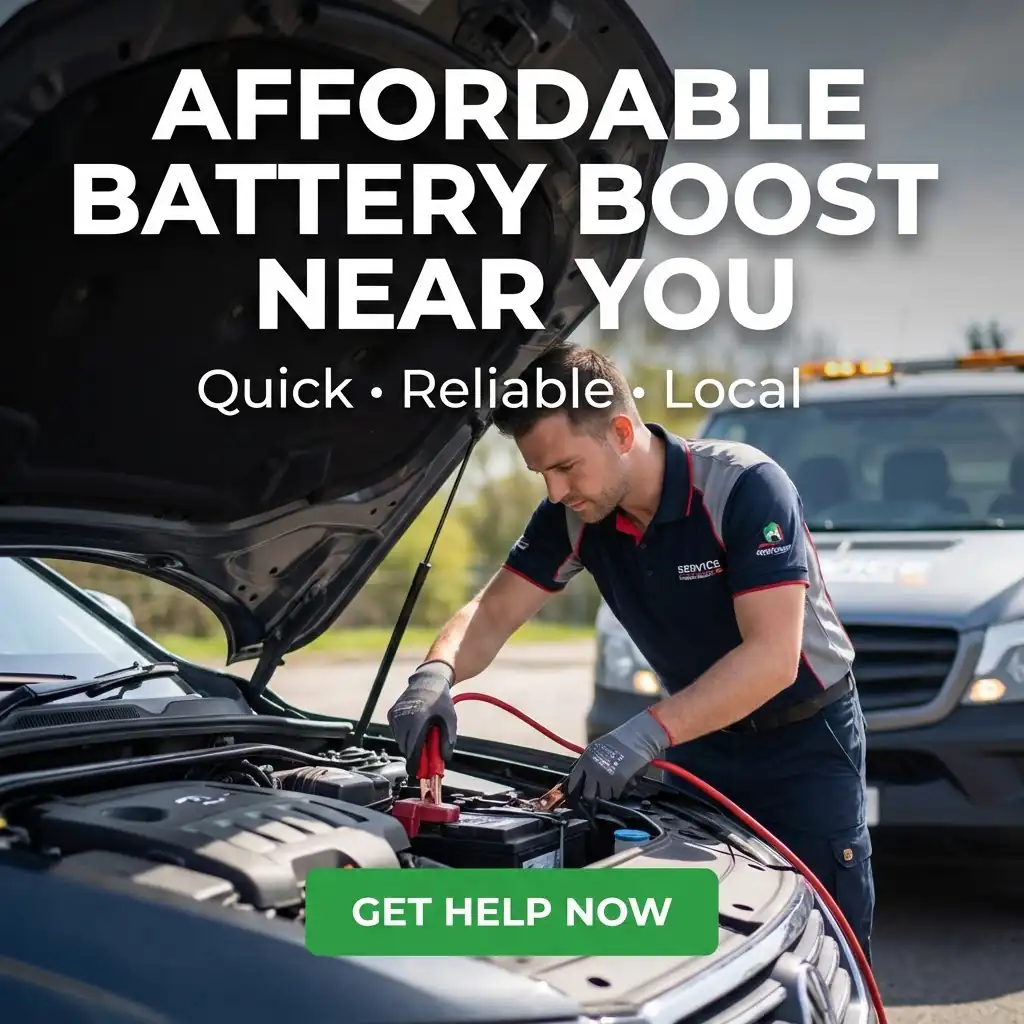
Unlike a DIY jump with cables, professional boost services use industrial-grade portable power packs that deliver clean, controlled voltage. No second vehicle needed. Average arrival in Kitchener: 20–30 minutes.
They Boost and Test Your Battery
The technician connects the power pack, jump starts your engine, and runs a quick battery health check. They’ll tell you whether the battery just needs a recharge (drive for 20–30 minutes) or whether it needs replacement soon. For realistic expectations on arrival times, read our guide on what drivers should realistically expect in emergencies.
You Drive Away
Once the engine is running, the alternator begins recharging your battery. Drive for at least 20 minutes before shutting off the engine again. If the battery can’t hold a charge, the technician can arrange a tow to a mechanic right then.
💡 Pro Tip
After a jump start, drive directly to your destination — don’t stop to run a quick errand on the way. Each time you shut off and restart the engine before the battery has fully recharged, you risk getting stranded again. A 20–30 minute continuous drive is the minimum to rebuild a usable charge.
Why DIY Jump Starts Can Damage Modern Cars
Twenty years ago, jump starting a car with cables from a neighbour’s vehicle was simple and safe. Today’s vehicles are a different story. Here’s why a professional battery boost service is worth the call:
- Voltage spikes can fry electronics — modern cars have dozens of sensitive computer modules (ECUs). An uncontrolled surge from jumper cables can damage everything from your infotainment system to your transmission controller. Repair cost: $500–$2,000+.
- Reverse polarity risk — connecting cables to the wrong terminals (positive to negative) can instantly destroy the battery, blow fuses, damage the alternator, and short-circuit wiring. Professional power packs have reverse-polarity protection built in.
- Hybrid and electric vehicle batteries — attempting to jump a hybrid’s 12V auxiliary battery incorrectly can damage the high-voltage system. Always call a professional for any hybrid or EV battery issue.
- Battery hydrogen gas — a dead battery can off-gas flammable hydrogen. A spark from improperly connected cables near the battery can cause an explosion. Professional technicians connect to grounding points away from the battery to eliminate this risk.
⚠️ Never Jump Start a Swollen or Leaking Battery
If your battery casing is bulging, cracked, or leaking fluid, do not attempt a jump start — it could rupture or explode. A swollen battery means internal failure. Call for a tow to a mechanic for safe battery replacement instead.
How Much Does a Jump Start Cost in Kitchener?
A professional battery boost is one of the most affordable roadside services you can call for. Here’s what Kitchener-area drivers typically pay:
For a quick estimate based on your location, use our towing cost estimator. For tips on keeping costs down, see our guide on affordable towing in Kitchener. Our detailed towing rates explained page breaks down pricing for every service type.
Car Won’t Start? We’ll Get You Going.
Professional battery boost service across Kitchener, Waterloo & Cambridge — 24/7.
Jump Start vs. Battery Replacement: Which Do You Need?
A jump start gets you running, but it doesn’t fix a failing battery. Here’s how to tell whether a boost is enough or you need a full replacement:
If a boost doesn’t work or your battery dies again within a day, you likely need a new battery ($150–$350 installed) or an alternator diagnosis. A professional boost technician can test your battery on-site and tell you which route to take before you spend a dollar at a mechanic. If the car needs a tow, we offer both flatbed towing and breakdown towing to get your vehicle to a shop safely.
What Kills Car Batteries in Kitchener?
Kitchener’s climate is particularly hard on car batteries. Here are the top reasons we see battery boost calls spike in the Waterloo Region:
Extreme Cold (November – March)
Cold is the number one battery killer. At -20°C, a fully charged battery loses about 50% of its cranking power — while your engine needs more power to turn over in thick, cold oil. This is why Kitchener tow companies see 3–4x more boost calls in January and February than any other month.
Short Trips That Don’t Recharge the Battery
If your daily commute is under 15 minutes, the alternator never fully recharges the battery. Over weeks, the battery’s charge level slowly drops until one morning it can’t start the car. This is extremely common for Kitchener–Waterloo commuters who drive short distances between downtown neighbourhoods.
Leaving Lights or Accessories On
Dome lights, headlights, USB chargers, and dashcams can drain a battery overnight. Some modern vehicles have parasitic draw issues where electronics continue pulling power even when the car is off.
Old Age
The average car battery lasts 3–5 years in Canadian climates. After that, it can fail without warning — often on the coldest morning of the year. According to the CAA, dead batteries are the single most common roadside assistance call in Ontario.
Corroded or Loose Terminals
White or greenish buildup on battery terminals disrupts the electrical connection. Sometimes what looks like a dead battery is actually a corrosion problem that a simple terminal cleaning fixes. A boost technician can check for this during the service call.
Can You Jump Start a Car Yourself?
You can jump start a car yourself with jumper cables and a second vehicle — but only if you follow the correct procedure. Here’s the safe order:
- Position the donor car close — nose to nose or side by side, close enough for cables to reach, engines off.
- Connect red cable to dead battery’s positive (+) terminal first.
- Connect other red cable to donor battery’s positive (+) terminal.
- Connect black cable to donor battery’s negative (−) terminal.
- Connect other black cable to an unpainted metal surface on the dead car’s engine block — NOT the negative battery terminal. This prevents sparks near the battery.
- Start the donor car, wait 2–3 minutes, then try starting the dead car.
- Remove cables in reverse order — black from engine block first, then black from donor, then both reds.
⚠️ When NOT to Jump Start Yourself
Skip the DIY jump and call a professional if: your battery is visibly swollen or leaking, you drive a hybrid or electric vehicle, you’re unsure which terminals are positive vs. negative, you’re on a busy road or highway shoulder, or it’s dark and you can’t clearly see the battery terminals. In any of these cases, call for a professional battery boost.
Should You Buy a Portable Jump Starter?
Portable lithium jump starters (compact battery packs the size of a thick smartphone) have become popular. Here’s an honest assessment:
Check consumer reviews and buy a reputable brand (NOCO, Schumacher, or DeWalt are well-reviewed). Look for at least 1,000 peak amps for 4-cylinder engines and 2,000+ for V6/V8. Keep it charged monthly and store it inside your house — not in a frozen trunk.
Does Insurance Cover a Battery Boost?
Basic Ontario auto insurance does not cover roadside battery boost service. But many drivers have coverage through other sources without knowing it:
- Insurance roadside assistance add-on — typically $5–$15/month, covers battery boosts, tire changes, and short tows. Check your policy declarations page.
- CAA membership — all tiers include battery boost and jump start service across Ontario, usually with 3–4 service calls per year.
- Credit card benefits — some premium Visa and Mastercard cards include roadside assistance that covers battery boost.
- New vehicle warranty — many manufacturers include 3–5 years of complimentary roadside assistance with new car purchases.
Our complete guide on how to check if your insurance covers emergency towing walks you through exactly where to find this information. You can also visit our insurance towing page to understand how claims work.
How to Prevent Dead Batteries in Kitchener’s Climate
You can dramatically reduce your risk of needing a jump start with these habits:
- Get your battery tested every fall — most auto parts stores and mechanics will test battery health for free. Do it before the first cold snap in November.
- Replace batteries proactively at 4 years — don’t wait for it to fail on a -20°C morning. A preemptive $200 replacement beats a $100 boost call plus the stress of being stranded.
- Use a battery maintainer if parked for extended periods — a trickle charger ($30–$50) keeps the battery topped up during vacations or seasonal storage.
- Take a 20+ minute drive at least once a week — short trips don’t give the alternator enough time to recharge the battery.
- Clean battery terminals annually — a wire brush, baking soda, and water remove corrosion in 5 minutes. Apply terminal grease afterward to prevent future buildup.
- Park in a garage when possible — even an unheated garage is 10–15°C warmer than outside, which helps maintain battery performance.
- Use a block heater in extreme cold — a block heater warms the engine, reducing the cranking load on your battery during cold starts.
Taking these steps won’t guarantee you’ll never need a boost — but they’ll dramatically reduce the odds. Check whether your vehicle has any active battery-related recalls at the Transport Canada vehicle recalls database. For a deeper look at warning signs, read the 5 warning signs your car battery is about to die.
Kitchener Areas We Serve for Battery Boost
Our battery boost and jump start service covers every neighbourhood in Kitchener and the wider Waterloo Region:
Whether you need a car battery boost in Kitchener at your driveway, a parking garage in Waterloo, or a rest stop on the highway — call our 24/7 dispatch and we’ll send the nearest available technician. For other roadside emergencies, explore our full services page.
Frequently Asked Questions About Jump Starting a Car
How much does a battery boost cost in Kitchener?
A standard battery boost in Kitchener typically costs $60 to $100 during daytime hours. After-hours and weekend service may include a surcharge of $20 to $40. Most providers include a basic battery health test as part of the service.
How fast will a jump start service arrive?
In Kitchener, Waterloo, and Cambridge, most battery boost technicians arrive within 20 to 30 minutes during normal conditions. Response times may be longer during extreme cold snaps when call volume spikes.
Can a jump start damage my car?
A properly performed jump start does not damage your vehicle. However, an improper DIY jump using cables — such as connecting to the wrong terminals or creating a voltage spike — can damage sensitive electronics. Professional boost services use regulated power packs that prevent these risks.
How long do I need to drive after a jump start?
Drive for at least 20 to 30 minutes continuously after a jump start. This gives the alternator enough time to recharge your battery to a usable level. Avoid shutting off the engine for short stops during this recharge drive.
Why does my car battery keep dying?
Repeated dead batteries usually indicate the battery is old and needs replacement, the alternator is failing to recharge it, there is a parasitic electrical draw draining the battery when the car is off, or you are consistently making short trips that don’t allow the alternator to fully recharge the battery.
Can you jump start a car in the rain?
Yes. It is safe to jump start a car in the rain. Car electrical systems operate at 12 volts, which is not dangerous in wet conditions. However, visibility is reduced and surfaces are slippery, so professional service is recommended for safety during heavy rain, especially on roadsides.
How long does a car battery last in Ontario?
In Ontario’s climate, the average car battery lasts 3 to 5 years. Extreme temperature swings from hot summers to freezing winters accelerate battery degradation. Getting your battery tested each fall before winter is the best way to avoid a surprise failure.
Does insurance cover battery boost service?
Standard Ontario auto insurance does not include battery boost. However, many drivers have coverage through a roadside assistance insurance add-on, CAA membership, premium credit card benefits, or new vehicle warranty. Check your policy declarations page or call your insurer to confirm.
What if a jump start doesn’t work?
If a jump start doesn’t get your engine running, the battery may be completely dead beyond recovery, the starter motor may be faulty, or the alternator may have failed. In these cases, the vehicle will need a tow to a mechanic for diagnosis and repair — which your roadside technician can arrange on the spot.
Is 24/7 battery boost available in Kitchener?
Yes. Kitchener Towing offers 24-hour battery boost and jump start service 7 days a week, including holidays. Call (226) 476-0477 any time for immediate dispatch across Kitchener, Waterloo, Cambridge, and surrounding areas.
Dead Battery? We’re on the Way.
Professional battery boost with industrial power packs — no cables needed.
24/7 across Kitchener • Waterloo • Cambridge