Can You Tow an AWD or 4WD Vehicle? What You Need to Know
All-wheel drive vehicles are everywhere in Kitchener. Subaru Outbacks in Waterloo. Toyota RAV4s in Cambridge. Tesla Model Ys on the 401. Honda CR-Vs in every neighbourhood. According to industry data, AWD now accounts for more than half of all new vehicle sales in Canada — which means more than half of all tow calls now involve a vehicle that requires flatbed transport to avoid drivetrain damage.
The problem is that not every tow operator understands this — or cares. A wheel-lift truck arrives, hooks up your AWD Subaru by the front wheels, and tows it 15 km to a mechanic. The rear wheels spin freely on the road. The centre differential, which is designed to allow front and rear axles to turn at slightly different speeds, is now being forced to operate without engine-driven lubrication. Metal grinds on metal. By the time you reach the shop, the transfer case is destroyed.
This guide explains why AWD and 4WD vehicles need rollback transport, what specific damage occurs from improper towing, which vehicles are affected, what about electric vehicles, and how to make sure the tow company sends the right equipment. For a detailed comparison of tow truck types, see our companion post on wheel-lift vs. flatbed towing. For immediate service, call our flatbed towing team at (226) 476-0477.
Why AWD and 4WD Vehicles Cannot Be Wheel-Lift Towed
To understand the risk, you need to understand how AWD and 4WD drivetrains work — and why towing breaks them:
- AWD systems connect all four wheels to the engine through a centre differential or transfer case. When the engine runs, it lubricates these components through oil circulated by internal pumps. When the engine is off, the pumps stop — but the gears and bearings are still engaged.
- Wheel-lift towing leaves two wheels on the road. Those wheels spin as the car is towed, which forces the connected differential and driveshaft to rotate. Without the engine running, there is no oil pressure — the gears run dry.
- Dry gears destroy themselves within minutes. Bearings overheat, gear teeth shear, seals fail, and metal shavings contaminate the entire drivetrain. The damage happens fast — often within the first 1–2 km of towing.
$3,000–$5,000
Centre Differential Replacement
AWD vehicles (Subaru, RAV4, CR-V)
$4,000–$8,000
Transfer Case + Transmission
4WD trucks (F-150, Silverado, Ram)
$5,000–$15,000+
EV Battery + Motor Damage
Tesla, Ioniq, EV6, Bolt
Which Vehicles Need a Flatbed? Complete Guide
This is the reference list Kitchener drivers need. If your vehicle is on this list, always request flatbed transport — no exceptions:
💡 How to Check If Your Vehicle Is AWD
Check the badge on the rear of the vehicle — look for “AWD,” “4WD,” “4×4,” “Quattro,” “xDrive,” “4MATIC,” or “HTRAC.” You can also find drivetrain info on the sticker inside the driver’s door jamb, in the owner’s manual, or by searching your VIN at the NHTSA VIN decoder.
AWD? 4WD? EV? We Send the Right Truck.
Rollback fleet dispatched 24/7 across Kitchener, Waterloo & Cambridge. Drivetrain-safe towing guaranteed.
Electric Vehicles: A Special Case
EVs require rollback transport for a completely different reason than AWD/4WD vehicles. It’s not about differential lubrication — it’s about regenerative braking and motor back-drive:
- Electric motors are also generators — when EV wheels spin (even with the car off), the electric motors generate current. This is how regenerative braking works during normal driving — but during towing, that current has nowhere to go safely.
- Uncontrolled current damages the battery — the generated electricity can overheat the battery management system, damage power electronics, and in worst cases cause thermal runaway (battery fire).
- “Transport mode” is not always enough — some EVs like Tesla have a “Transport Mode” setting, but this only disengages the parking brake. The motors may still generate current. The only truly safe option is rollback transport with zero wheel rotation.
With EVs becoming increasingly common on Kitchener roads, this is a growing concern. According to Transport Canada, all-electric vehicles should be transported on flatbed equipment to avoid damage to the electric powertrain. Our flatbed service handles EV towing regularly — including Teslas, which require specific loading procedures due to their low ground clearance and heavy battery packs.
AWD vs. 4WD: What’s the Difference?
Drivers often use “AWD” and “4WD” interchangeably, but they’re mechanically different systems. Both require all-wheels-off-ground transport, but for slightly different reasons:
AWD (All-Wheel Drive)
Power goes to all four wheels continuously or on demand. A centre differential or coupling splits torque between front and rear axles. Common in cars and crossover SUVs. The centre differential is permanently engaged — towing with any wheels on the ground forces it to spin dry.
Examples: Subaru Symmetrical AWD, Audi Quattro, Mazda i-Activ AWD
4WD (Four-Wheel Drive)
Power goes to all four wheels through a transfer case, typically selectable (2WD/4WD High/4WD Low). Common in trucks and body-on-frame SUVs. Even in 2WD mode, the transfer case and front driveshaft may remain partially engaged, making wheel-lift risky.
Examples: Ford 4×4, Chevy Z71, Jeep 4WD, Toyota TRD Off-Road
How to Protect Your Vehicle When Calling for a Tow
Follow these steps every time you call for a flatbed tow to ensure your AWD, 4WD, or EV is handled correctly:
- State your drivetrain type immediately — “I have an AWD Subaru Outback” or “I have a 4WD F-150” or “I have a Tesla Model Y.” This tells dispatch to send a flatbed, not a wheel-lift.
- Request a flatbed explicitly — say “I need a flatbed” even if you think they already know. Confirming verbally creates accountability.
- Verify when the truck arrives — if a wheel-lift truck shows up instead of a flatbed, do not allow the tow to proceed. Call dispatch and confirm the equipment mismatch.
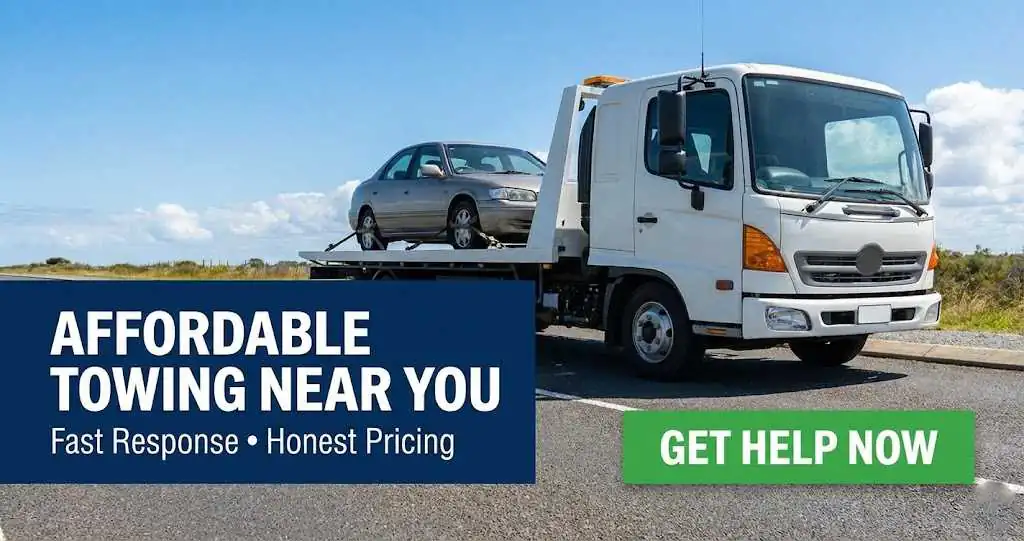
- Watch the loading process — the vehicle should go onto the flatbed with all four wheels off the ground. No wheels should touch the road during transport.
- Document the tow — take a photo of the vehicle loaded on the flatbed. If improper towing ever causes damage, this photo proves it was loaded correctly (or wasn’t).
At Kitchener Towing, our dispatch confirms drivetrain type on every call and sends the appropriate equipment automatically. For your legal rights when calling a tow in Ontario, see our Ontario towing laws guide. For pricing, see Kitchener towing rates or use the cost estimator. For how flatbed towing specifically protects your drivetrain components, read our detailed post on flatbed drivetrain protection. Check our response time guide for arrival expectations, and see how insurance covers towing for coverage questions. For all other services, browse our full list — emergency towing, roadside assistance, 24-hour towing, and affordable towing.
Frequently Asked Questions
Can you tow an AWD car with a wheel-lift?
No. Towing an AWD vehicle with any wheels on the ground can destroy the centre differential, transfer case, and transmission. The only safe method is flatbed transport where all four wheels are completely off the ground. Even short-distance wheel-lift towing can cause permanent damage to an AWD drivetrain.
How much does it cost to tow an AWD on a flatbed in vehicle in Kitchener?
A local flatbed pickup within Kitchener typically costs $100 to $200. The rollback premium over a standard wheel-lift is usually only $25 to $75 — far less than the $3,000 to $8,000 drivetrain repair that improper towing can cause. Pricing is confirmed before dispatch.
What happens if my AWD car was towed incorrectly?
If your AWD vehicle was wheel-lift towed, have the drivetrain inspected immediately by a qualified mechanic. Symptoms of towing damage include grinding noises from the centre or rear differential, vibrations at highway speed, difficulty turning, and transmission warning lights. If the tow company caused the damage, you may have a claim against them — document everything and consult a mechanic for a written assessment.
Can a Tesla be towed with a wheel-lift?
No. Tesla explicitly requires rollback transport for all models. Towing with wheels on the ground back-drives the electric motors, generating uncontrolled current that can damage the battery management system and power electronics. Tesla’s owner’s manual states that improper towing voids the warranty for related damage.
Is my Subaru AWD or FWD?
Almost all Subarus sold in Canada are AWD. The only exception is the Subaru BRZ, which is rear-wheel drive. Every other Subaru model — Outback, Forester, Crosstrek, Impreza, WRX, Legacy, Ascent — uses Subaru’s Symmetrical All-Wheel Drive system and must be transported on a rollback.
Can I put my 4WD truck in 2WD mode and use a wheel-lift?
This is risky and generally not recommended. Even in 2WD mode, some 4WD systems keep the front driveshaft partially engaged. The transfer case may still rotate components that are not designed to spin without engine oil pressure. The safest approach is always flatbed — the cost difference is minimal compared to the risk.
How quickly can a flatbed arrive in Kitchener?
Typical flatbed arrival time in Kitchener, Waterloo, and Cambridge is 20 to 40 minutes. Our flatbed fleet dispatches 24 hours a day, 7 days a week. Call (226) 476-0477 for immediate dispatch.
Does towing a hybrid vehicle require a flatbed?
It depends on the hybrid type. Plug-in hybrids with electric-only drive modes such as the Toyota RAV4 Prime or Mitsubishi Outlander PHEV should be transported on a rollback. Traditional hybrids like the Toyota Prius can sometimes be wheel-lift towed in neutral, but a rollback truck is always the safer choice. Check your owner’s manual for the manufacturer’s specific towing instructions.
Will improper towing void my vehicle warranty?
Many manufacturers explicitly state in the owner’s manual that improper towing voids the drivetrain warranty for related damage. Tesla, Subaru, Audi, and BMW all have specific towing instructions requiring flatbed transport. If a tow company damages your drivetrain through improper towing, the manufacturer may deny the warranty claim and direct you to recover costs from the tow company.
What if I break down on the highway with an AWD vehicle?
Pull safely onto the shoulder, turn on hazard lights, and call (226) 476-0477. Tell dispatch you have an AWD vehicle and need a flatbed. Stay inside the vehicle until the truck arrives. On highways like the 401, a flatbed can usually arrive within 20 to 30 minutes. For more details on safe highway breakdowns, see our breakdown towing guide.
Your AWD Deserves a Flatbed. Every Time.
Drivetrain-safe towing for AWD, 4WD, EV, and luxury vehicles — 24/7.
Kitchener • Waterloo • Cambridge • All of Waterloo Region