
Run-Flat Tires vs. Spare Tires: What Kitchener Drivers Need to Know
If you’ve ever searched “tire repair near me” after a flat in Kitchener, you’ve probably wondered whether your flat tire situation could have been avoided entirely. The answer depends on what’s on your wheels — and what’s in your trunk. The debate between run-flat tires vs spare tires is one that every driver should settle before a flat leaves them stranded on King Street or the Conestoga Parkway.
Modern vehicles have made this decision more complicated. About one in three new cars sold in Canada no longer includes a spare tire. Some come with run-flats. Others rely on a sealant kit and an air pump. And a surprising number of drivers don’t know which option their vehicle has until the day they need it.
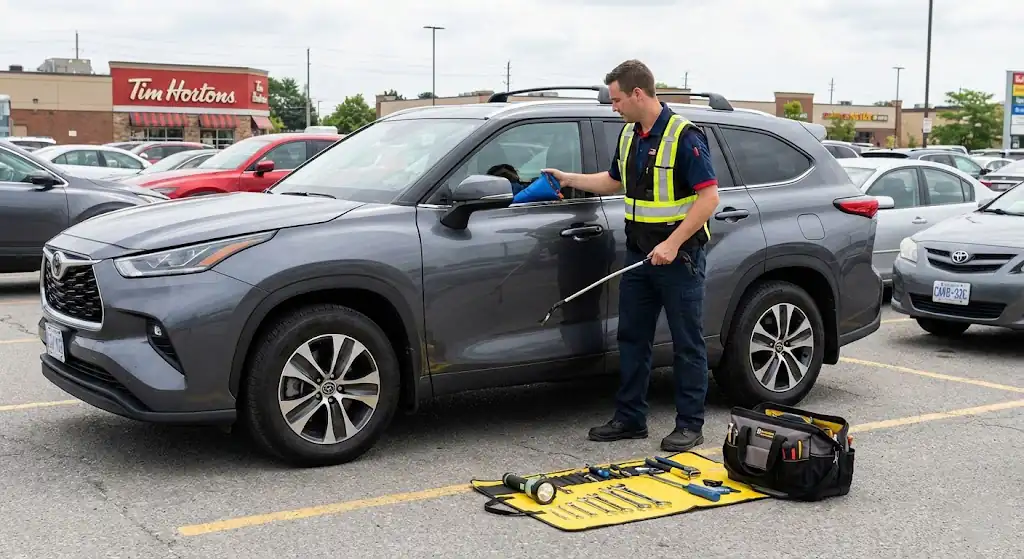
This guide breaks down every option — run-flat tires, full-size spares, donut spares, and sealant kits — so you know exactly what you’re working with and what to do when a flat strikes. If you’ve already got a flat right now, skip straight to our mobile tire change service or call (226) 476-0477.
What Are Run-Flat Tires?
A run-flat tire is engineered with reinforced sidewalls that support the vehicle’s weight even after a complete loss of air pressure. Unlike a standard tire that collapses when punctured, a run-flat keeps its shape and allows you to keep driving — typically up to 80 kilometres at a maximum speed of 80 km/h.
Run-flats are factory-installed on many BMW, MINI, Mercedes-Benz, and some Lexus models. Your vehicle must have a Tire Pressure Monitoring System (TPMS) to use run-flats, because the ride feels so similar to a normally inflated tire that you might not notice a puncture without the dashboard warning.
🔍 How to Tell If You Have Run-Flat Tires
Check the sidewall markings. Run-flats are labeled with codes like ROF (Goodyear), RFT (Bridgestone), SSR (Continental), ZP (Michelin), or RSC (BMW RunFlat System Component). If you don’t see any of these codes, you have standard tires and need a spare or sealant kit as backup.
What Are Your Spare Tire Options?
Spare tires come in two main varieties, and the one in your trunk determines how far and how fast you can drive after a flat:
Most sedans, crossovers, and compact SUVs that still include a spare come with a donut. Full-size spares are more common on pickup trucks and full-size SUVs. If your vehicle came with neither, our guide on handling flats in vehicles without a spare covers your options.
Run-Flat Tires vs. Spare Tires: Full Comparison
Here’s a head-to-head breakdown so you can decide which option makes the most sense for your vehicle and driving habits in the Kitchener-Waterloo area:
Neither option eliminates the need for professional help entirely. Run-flats get you to a shop — but the tire usually needs full replacement. Spare tires get you rolling — but they’re temporary. In both cases, a quick search for “tire repair near me” in Kitchener will point you to the right service. Or you can skip the search and call our 24/7 roadside assistance directly.
If you have roadside coverage through CAA South Central Ontario or your insurance, tire change is usually included. Check our guide on how car insurance covers emergency towing to see if you’re already covered.
What About Tire Sealant Kits?
Many 2020+ vehicles — including popular models like the Hyundai Tucson, Kia Sportage, Chevrolet Equinox, and Toyota Corolla — skip both run-flats and spares entirely. Instead, they include a tire sealant kit (sometimes called an “inflator kit” or “tire mobility kit”) that consists of a bottle of sealant and a small 12V air compressor.
Here’s the reality of how these kits perform:
⚠️ Check Your Sealant Expiry Date
Tire sealant expires — most kits are only good for 4–6 years from manufacture. If your car is a few years old, the sealant that came with it may already be expired and useless. Check the expiry date printed on the canister and replace it if needed.
Flat Tire? We Come to You — Any Option, Any Location.
Spare swap, run-flat tow, or roadside diagnosis. 24/7 across Kitchener, Waterloo & Cambridge.
Which Option Is Best for Kitchener Drivers?
There’s no one-size-fits-all answer — the right choice depends on how you drive, where you drive, and what kind of flat tire scenarios worry you most. Here’s a quick decision framework based on common Kitchener-area driving patterns:
🏙️ City Commuter (Kitchener–Waterloo daily driver)
Best choice: Run-flat tires. You’re always within 80 km of a tire shop. Run-flats let you skip the roadside stop entirely and drive directly to a tire repair shop. The stiffer ride is barely noticeable on Kitchener’s urban roads.
🛣️ Highway Commuter (401, Highway 7/8 regularly)
Best choice: Run-flat tires. Highway shoulders are dangerous. Run-flats mean you don’t have to stop and change a tire next to 100+ km/h traffic. Read our guide on why breakdown location matters for context on highway risk.
🏕️ Rural / Long-Distance Driver (Muskoka, cottage country)
Best choice: Full-size spare tire. In rural areas, the nearest tire shop can be 50+ km away. A full-size spare gives you unlimited range at normal speed — no 80 km limit. Plus, run-flat replacements are nearly impossible to find in small-town Ontario.
💰 Budget-Conscious Driver
Best choice: Donut spare + know how to change it (or save a tow company’s number). A donut costs $60–$150 once. Run-flats cost $200–$500 per tire and need replacing as a set. The cost difference over 4 tires is $800–$2,000+. For pricing on professional help, visit our towing rates page.
❄️ Winter Driver (October – April in Ontario)
Best choice: Standard winter tires + donut spare. Winter run-flat options are extremely limited in Canada. Most tire shops in Kitchener stock zero winter run-flat models. Standard winter tires with a compact spare is the practical winter setup.
The Hidden Downsides of Run-Flat Tires
Run-flats solve the “stranded on the roadside” problem, but they introduce trade-offs that many drivers don’t discover until replacement time:
- They cost 30–60% more per tire — a set of four run-flats can cost $800–$2,000+ compared to $500–$1,200 for comparable standard tires
- They usually can’t be repaired — once a run-flat loses pressure and you’ve driven on it, the reinforced sidewall may be compromised even if the puncture is small and repairable on a standard tire
- Harsher ride quality — the reinforced sidewalls that make run-flats work also transmit more road vibration and impact into the cabin, which is noticeable on Kitchener’s pothole-heavy roads
- Limited availability — if you need a replacement on short notice, many local tire shops may need to order them, leaving you waiting 1–3 business days
- Shorter tread life — the stiffer compound wears faster, so you’ll replace them sooner than standard tires
None of these are dealbreakers — but they’re worth knowing before you commit to a $1,500+ tire purchase. If a run-flat does go flat and you can’t make it to a shop, call for flatbed towing rather than a tire change, since run-flats often need a shop to assess whether the sidewall is still structurally sound.
When You Need Tire Repair Near Me in Kitchener
Regardless of which tire option you choose, there are situations where none of them can save you and you’ll need to search for tire repair near me in Kitchener:
- Your run-flat has driven beyond its limit — if you exceeded the 80 km range or didn’t notice the TPMS warning, the tire is destroyed
- Your spare is flat — many drivers discover this at the worst possible moment because they never check spare pressure
- Your sealant failed — sidewall punctures, large holes, and old sealant all mean the kit is useless
- You can’t physically change the tire — lug nuts too tight, bad weather, unsafe location, or no experience
- Multiple tires are damaged — hitting road debris or a deep pothole can damage two or more tires at once
In any of these scenarios, professional roadside tire service is the fastest resolution. A mobile technician can change a spare, assess run-flat damage, or arrange a tow to the nearest tire shop. For realistic arrival times, check our post on what drivers should realistically expect in emergencies.
Cost Comparison: Total Ownership Over 5 Years
Looking at the full cost picture — not just the sticker price — helps you make a smarter long-term decision:
Run-flats offer convenience at a premium. Standard tires with a spare offer savings and repairability. Use the towing cost estimator to see what a roadside service call would add to either option, and check out our tips on affordable towing in Kitchener.
Can You Switch from Run-Flats to Standard Tires?
Yes — this is a common question from BMW and MINI owners in Kitchener, and the answer is straightforward. You can switch from run-flat tires to standard tires as long as you:
- Buy a spare tire — since you’ll no longer have run-flat protection, you need a backup plan. A donut spare is the most common choice.
- Confirm your TPMS still works — the tire pressure monitoring system should function with standard tires, but verify with your mechanic.
- Replace all four tires at once — mixing run-flats with standard tires causes uneven handling and is unsafe.
- Understand you’ll need roadside service — without run-flats, a highway flat means you’ll need to stop and either change the tire yourself or call for help.
Many drivers switch to save money and improve ride comfort. The trade-off is losing the ability to drive on a flat — which means keeping a 24-hour towing number saved in your phone becomes essential. If you’re unsure how the swap affects your drivetrain during towing, read our guide on flatbed protection for sensitive vehicles.
💡 Pro Tip
If you switch from run-flats to standard tires, buy a compact donut spare and a basic tool kit (jack, lug wrench, wheel chock). Store them where the run-flat cargo space was. Total cost: $100–$200 — far less than one run-flat tire replacement. If you’d rather not change it yourself, make sure your insurance covers roadside service.
How to Check What’s in Your Trunk Right Now
Take two minutes and check — it’s better to know before you need it. Here’s how:
- Open your trunk and lift the floor mat or cargo liner. Most spare tires sit in a recessed compartment underneath.
- If you see a tire — check whether it’s a full-size spare (same size as your other tires) or a smaller donut spare. Press the tread with your thumb to feel if it’s inflated.
- If you see a small bag or kit — that’s a tire sealant/inflator kit. Check the expiry date on the sealant canister.
- If you see nothing — check your tire sidewalls for run-flat codes (ROF, RFT, SSR, ZP, RSC). If no codes, you have no flat-tire backup at all.
If your spare tire is flat or you have no backup plan, make sure you have a reliable towing service number saved. You can also check whether your vehicle is affected by any tire-related safety recalls at the Transport Canada vehicle recalls database.
Kitchener Tire Repair: Where to Go for Help
Whether you drive on run-flats, keep a spare, or have nothing but a sealant kit — flat tires happen. When they do, Kitchener tire repair service is available across the entire Waterloo Region:
Our mobile tire change technicians handle spare swaps, run-flat assessments, and tows to the nearest repair shop. One call, one truck, one bill — no matter what type of tire is on your vehicle.
Frequently Asked Questions
Are run-flat tires worth it?
Run-flat tires are worth it for city and highway commuters who value convenience and safety — you never have to stop on a busy road to deal with a flat. However, they cost significantly more per tire, ride stiffer, and usually can’t be repaired. For budget-conscious or rural drivers, standard tires with a spare offer better long-term value.
Can you repair a run-flat tire?
In most cases, no. Once a run-flat tire has been driven on while flat, the internal sidewall structure may be compromised even if the puncture itself is minor. Most tire manufacturers and shops recommend full replacement. Some shops will patch a run-flat if it lost pressure slowly and wasn’t driven on while fully deflated.
How far can you drive on a run-flat tire when it’s flat?
Most run-flat tires allow you to drive up to 80 kilometres at a maximum speed of 80 km/h after a complete loss of pressure. The exact distance varies by manufacturer — check your owner’s manual for the specific rating on your tires.
Can I switch from run-flat tires to regular tires?
Yes. You can replace run-flat tires with standard tires on most vehicles. Make sure you replace all four at once, purchase a spare tire, and verify your TPMS still functions properly. Your dealer or a local tire shop in Kitchener can confirm compatibility for your specific vehicle.
How do I know if my car has run-flat tires?
Check the sidewall of your tire for manufacturer-specific run-flat codes: ROF (Goodyear), RFT (Bridgestone), SSR (Continental), ZP (Michelin), or RSC (BMW RunFlat). If you don’t see any of these markings, you have standard tires.
How long does a donut spare tire last?
A donut spare is designed for approximately 100 kilometres at a maximum speed of 80 km/h. It is a temporary solution only. Drive to the nearest tire shop for a permanent repair or replacement as soon as possible.
Do tire sealant kits actually work?
Sealant kits work for small tread punctures under 6mm. They do not work for sidewall damage, blowouts, or large holes. Additionally, sealant expires after 4 to 6 years, and using it may make the tire unrepairable afterward — turning a $30 patch job into a full tire replacement.
Where can I find tire repair near me in Kitchener?
For mobile tire repair in Kitchener, Waterloo, and Cambridge, call (226) 476-0477 for 24/7 roadside service. A technician can swap a spare, assess run-flat damage, or tow your vehicle to the nearest tire shop. Service covers all of the Waterloo Region.
Are winter run-flat tires available in Canada?
Winter run-flat options are extremely limited in Canada. Very few manufacturers offer winter-rated run-flat tires, and most Kitchener tire shops do not stock them. The practical winter setup for most drivers is standard winter tires combined with a compact donut spare.
How much do run-flat tires cost compared to regular tires?
Run-flat tires typically cost $200 to $500 per tire — roughly 30 to 60 percent more than comparable standard tires. A full set of four run-flats ranges from $800 to $2,000 or more, compared to $500 to $1,200 for standard tires plus $60 to $150 for a donut spare.
Flat Tire — Any Type? We Handle It.
Run-flat tow, spare swap, or roadside diagnosis — one call does it all.
24/7 service across Kitchener, Waterloo, Cambridge & beyond.